


Romania went shopping for a deterrent this month, and I can't stop reading the receipt.
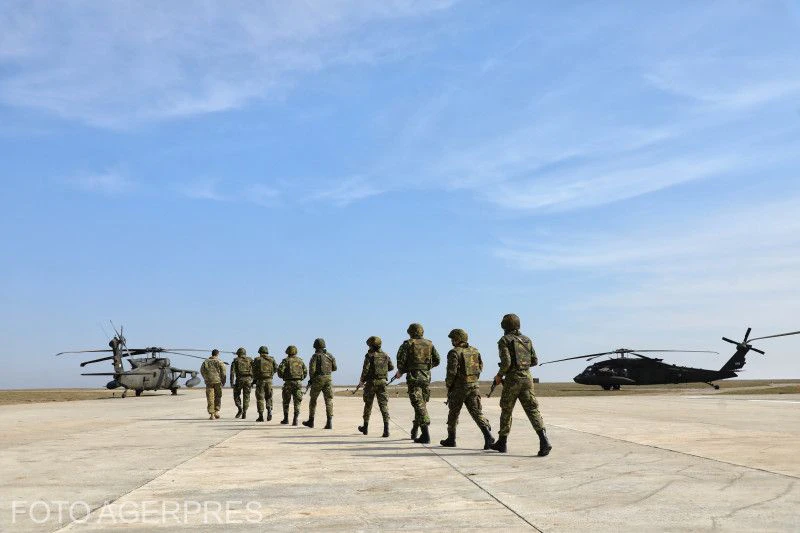
Bucharest has formally proposed to Washington that it will help cover the costs of keeping American troops in the country, and would like more of them too. The arrangement follows, in the reporting, "the Polish model, adjusted to Romania's standard of living." What a phrase. It is furniture-catalog language, and the item being configured is an airborne division.
And the configuration is where this stops being a story about money. The proposal, submitted to the United States with a cost-sharing framework, places its emphasis on the operational quality of the force rather than troop numbers alone. Romania's defense ministry talks about deploying a unit or elements from a formation such as the 101st Airborne Division, which it says would send a particularly potent deterrent message against any Russian threat. The ministry has also offered to accelerate construction of the facilities needed to house the troops and their families. One regional report, citing Bloomberg sources, puts the investment at roughly $4.5 billion, including modernizing the Mihail Kogălniceanu base through 2040. What is public is the configuration. The price tag itself is still a leak.
This is not an ally asking for reassurance. This is a customer at the counter specifying a package: here is the money, here is the base, here is the kind of unit we want to see, and here is when we want the renewal to come up for review. A base upgrade running to 2040 is not a deployment. It is a mortgage.
Now, paying for a welcome is nothing new. Japan and South Korea have shouldered garrison costs for decades, Washington has demanded fairer burden-sharing for years, and "alliances cost money" is the most boring true sentence in the field. If that were the story, I would leave it alone.
The story is the unbundling.
Look at what the parties are actually doing this month and the same conversion shows up at three different scales. At the garrison scale, Romania is not negotiating a percentage of GDP target. It is configuring a purchase: costed scenarios presented to the Pentagon official coordinating the review of American forces in Europe, quality traded against headcount, a named preferred formation, family housing thrown in. At the budget scale, Chancellor Friedrich Merz's formal letter of November 9 threatens not to approve the EU's next multi-year budget unless "all" member states share the cost of plugging Ukraine's roughly €70 billion 2027 shortfall. "Supporting Ukraine is a matter of our indivisible European security," he wrote, "and so must be the burden sharing for that support."
Indivisible security, with the invoice attached to the same sentence.
And at the diplomatic scale, Jared Kushner and Steve Witkoff are flying to Moscow to seek Vladimir Putin's "blessing" for European representatives to be allowed into future peace talks. "I believe that hopefully tomorrow in Moscow, Steve and I will be successful," Kushner said, "and President Putin will give the blessing for that to occur." He also offered, with what I take to be genuine bafflement, that "if Europe could identify one person to speak on their behalf, that would be a bigger achievement than getting the Russians to include them in the negotiation."
A garrison, a budget line, a seat at the table: three things that a single word, alliance, used to cover, now quoted separately, in separate negotiations, with separate counterparties. That is what I mean by unbundling. Not that someone is paying, but that protection is being sold by the item.
A purchased garrison has different physics from a shared one. Solidarity becomes a line item, and line items get cut in lean years.
I can hear the objections, and the strongest ones are in this week's own reporting. "We have European security architecture in place," the EU's Kaja Kallas said at Monday's G7 meeting in Paris. "The only one who is breaching that security architecture is Russia." Germany's foreign minister Johann Wadephul says Europe needs "the simple restoration of the existing security architecture," not a new one. Poland's Radosław Sikorski: "An arrangement about the future of Ukraine and of Europe above our heads would not just be unwise. It is actually impossible." Ursula von der Leyen wants a ceasefire before any architecture talk. And Washington and Brussels jointly declared that "a strong NATO will remain central to Euro-Atlantic collective defence." Fair. Nobody in these stories is standing at a podium announcing the end of collective defense.
But notice the currency these objections are in. Everyone defending the framework is arguing about architecture: which treaties were breached, who belongs at the table, what sequence is legitimate. The negotiation itself is running on something else entirely. It is running on costed proposals and calendar control. Colby's review of the entire American footprint produces options for the defense secretary, which reach the president for a decision expected in December on how many American personnel are deployed outside the United States. Meanwhile the American mediator flies to a warring president to secure permission for Europe to attend talks about Europe's own security arrangements. Reading that review as the provider shopping its deployments is my inference, I'll grant you. But watch who is holding the pen. When the decision that matters is which units stay where and on whose nickel, the price list is being written by whoever controls the deployment decision and the clock, not by whoever gives the most eloquent speech about Helsinki.
The clock everyone is negotiating around
- Nov 9Merz letter: no approval of the EU's 2028–2034 budget unless all member states share Ukraine's 2027 shortfall
- Nov 9At the G7 in Paris, Kallas answers that Europe's security architecture already exists and only Russia breaches it
- Nov 12Kushner and Witkoff meet Putin in Moscow, seeking his blessing for Europe to sit in on the talks
- Nov 12–13European Political Community and informal European Council meet in Dublin, Ukraine central
- DecemberDecision expected on how many US personnel are deployed abroad
The counter-reading I take most seriously is not that I have the wrong facts. It is that this is negotiating theater: costed offers staged before a December decision and a Dublin summit, and in January everyone goes back to NATO frameworks and host-nation support as usual. Maybe. But even a staged bid tells you what language the theater is now performed in. Nobody is staging a play about Article 5 solidarity. The props are unit configurations, maintenance cost shares, and renewal dates. When the aspirational fiction of an alliance turns into a quotation, something about the relationship has already changed, whether or not the deal closes.
What worries me is the physics of the thing. A promise was cheap to give and costly to break, and its vagueness was a feature: everybody heard what they needed to hear. Deterrence worked collectively in part precisely so that no single border had to outbid its neighbor. Once protection is quoted item by item, the bidding can begin, and the solidarity that was the whole point becomes a line item in someone's budget cycle. Line items get cut in lean years. A purchased guarantee can be downgraded, re-scoped, or simply not renewed, and none of those verbs used to apply to an alliance commitment. So here is the question I do not see anyone asking, and it is not whether burden-sharing is fair. If protection is retailed this way, what does the smallest customer get?
Security is being quoted at exactly the moment its terms are up for grabs.
That is the habit I would hand you for the next alliance headline. Read it as a pricing exercise. What is the unit: a soldier, a base, a seat at a table, a budget line? What does the package cover, and what is left as support rather than commitment? And what is the renewal condition, the review date at which someone gets to decide this was too expensive after all? These questions cut through the moral vocabulary of burden-sharing faster than any op-ed, because they ask what the document actually says.
Romania has discovered what a guarantee costs. The rest of Europe is about to learn what its guarantees are worth.



Comments