


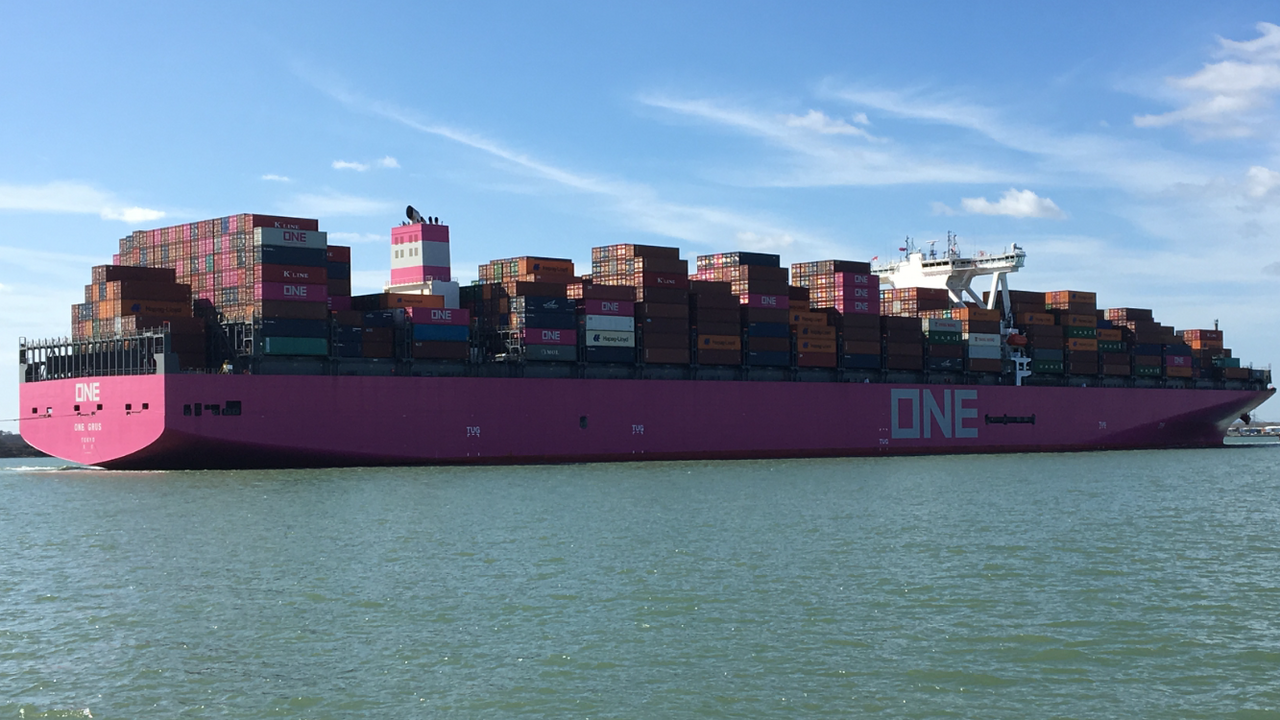
Ocean Network Express paints its ships magenta. Its branding agency says the color comes from Japan's cherry blossom and was chosen to stand out in a market of look-alike boxes. This week came word that ONE has sent a container ship through Bab al-Mandab for the first time in about three years. The news landed in the same cycle as the Houthis claiming the shore that overlooks the strait. Meanwhile, most ships crossing Hormuz do it with their transponders switched off. And last year, Red Sea ships took to broadcasting "ALL CHINESE" over AIS, which may be the cheapest insurance policy ever written.
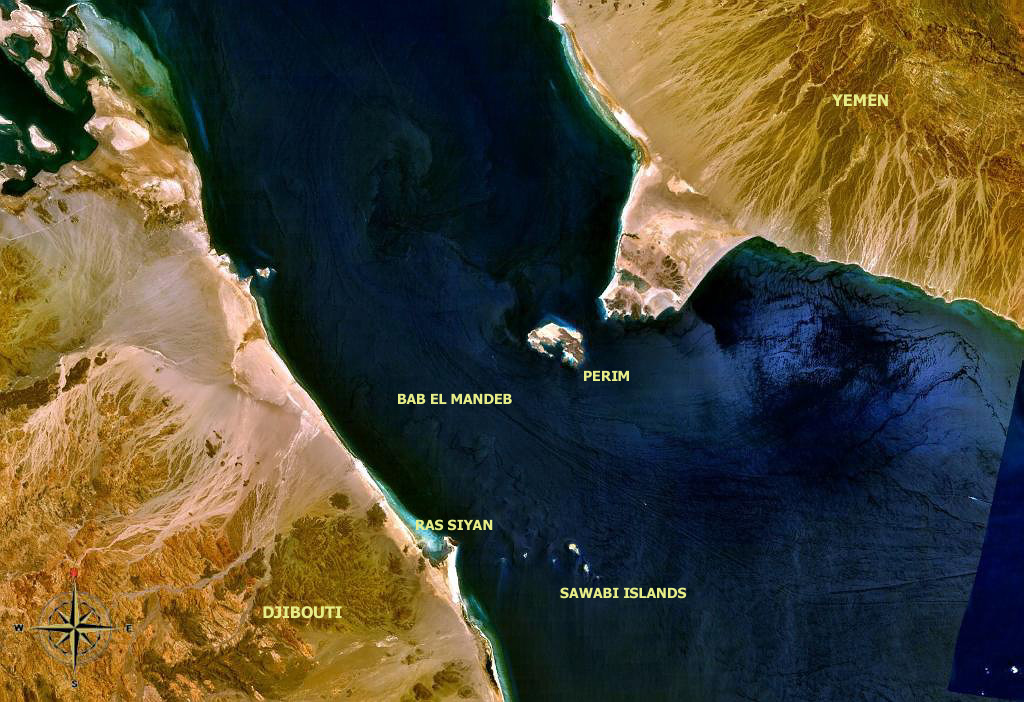
The Southern Armed Forces said it was withdrawing from an area overlooking the strategically important Bab al-Mandab Strait, at the southern end of the Red Sea, to reinforce positions around Aden and neighbouring areas. Houthi-run media say the movement has taken control of the evacuated territory. Saudi Arabia has not commented.
The reporting doesn't name the ship. But the picture works either way, because who holds the shore turns out to be a poor guide to what ships do. The map says hostile, and ships go anyway. You find out how dangerous a strait really is from the price of each trip through it. In Hormuz right now the barrels are nearly back to normal and the freight is many times normal. I think the freight is the number telling the truth.
Look at Bab al-Mandab from above and control seems like it should decide everything. The mouth is narrow, and Perim Island sits right in it, one of the places the Houthis said they captured in September. That seizure helped push oil prices up on territory alone. But listen to the people who now hold the shore. They say they pose no threat to international shipping and will keep targeting Saudi vessels. That's their claim, and similar promises didn't hold up in 2024. Notice what it does, though. Even the owners of the map sort by voyage: whose ship, whose cargo, which trip.
Hormuz is the same thing at a much larger scale. In October, Lloyd's List counted 418 transits by non-Iranian-linked tankers, the most of the war. In the same month it counted 37 confirmed attacks on merchant ships, also the most of the war. Ask those two numbers whether the strait is open and you get two different answers, and both are true. UKMTO has logged 144 incidents since the conflict began, and in about three quarters of them the ship carried on.
Insurers have priced it this way for a long time. War cover is typically quoted on a "48/7" basis. The quote is good for 48 hours, it covers seven days in the danger zone, and it's charged as a percentage of the hull's value. Your milk lasts longer than your premium. The London market publishes its own list of high-risk waters, coordinates and all, and then includes this line: "The application of this list on individual contracts will be a matter for specific negotiation." So the underwriters draw a map and then tell you not to read prices off it. Iran works the same way from the other side, with a blacklist of 45 named vessels. Danger here attaches to a hull, not to a stretch of water.
So how do the barrels come back before the safety does? The risk gets concentrated. Gulf crude is moving through shuttle tankers and ship-to-ship transfers that, in Lloyd's List's words, "concentrate risk on a relatively small group of vessels and crews" making the run again and again. Specialist crews get swapped in for the passage. And the industry is drawing in former Iranian, Russian and Venezuelan trading tonnage, ships that used to work the shadow trade, because they're the ones willing to go. Years of dodging sanctions turn out to be the right résumé for the legitimate business.
Put the numbers side by side and the picture is clear. Non-Iranian Middle East crude exports were 16.2 million barrels a day in October, only 800,000 below pre-war, by Kpler's count. Daily commercial traffic through the strait is in the single digits to low double digits, against 138 a day in 2025. A record 255 empty supertankers sat around the Middle East, about half the world's ballast fleet. And moving crude from the Gulf to China still averaged $36.64 a barrel. In January 2024, a spiking, much longer US Gulf to China voyage cost about $5. Ships weren't scarce. Willing ships were, and the freight premium is what the willing few charge to carry everyone else's danger.
That's why Brent can fall 16% in a week while the journey stays absurdly expensive. The oil price measures whether the barrels arrive. Freight measures what it cost someone to bring them.
Territory isn't nothing, and I won't pretend otherwise. The Houthi shore kept most carriers out of the Red Sea for about two years. Maersk said on December 24, 2023 that it would go back. About a week later the Maersk Hangzhou was attacked, and Maersk paused again. ONE is "expected to step up" Red Sea shipping, which is a forecast, not a plan. The map sets what the next voyage can cost, and one bad voyage can reset every quote after it. But even then the effect shows up as a price, not a switch.
Back then the politics said open and the ships stayed home. Now the politics says hostile and the ships go. I think I had the underwriter a little wrong. It's less a gate than a meter.
Iran's navy says a tanker caught fire after hitting a mine east of Hormuz. That came from state media, and Reuters couldn't verify it. Brent slipped 0.49%, basically a shrug. If the mine was real and it mattered, the oil price won't be what tells us. The next 48-hour quote for the next tanker will.



Comments