

The Cost of Keeping Moving
BYD is buying eighteen car carriers, Ukraine just discovered its satellite link can change without warning, and ASML's customers are queuing to buy chip tools for 2030. I think it's all one purchase — and the price tells you what the next decade is expected to feel like.

A car company is building a fleet of ships. The monopoly that makes the machines that make chips says its customers are lining up to place orders for 2030. And a country at war just found out that the satellite link its drones depend on can be changed overnight, without warning. I think these are the same purchase.
Start with the ships. BYD, the world's biggest electric vehicle maker, is going from eight car carriers to eighteen by 2029 — each new vessel good for about 9,200 cars, built by China Merchants Industry. The boring filing is "vertical integration, Chinese edition: automaker buys boats." I don't think that's what this is. I think BYD is buying the right never to be told no.
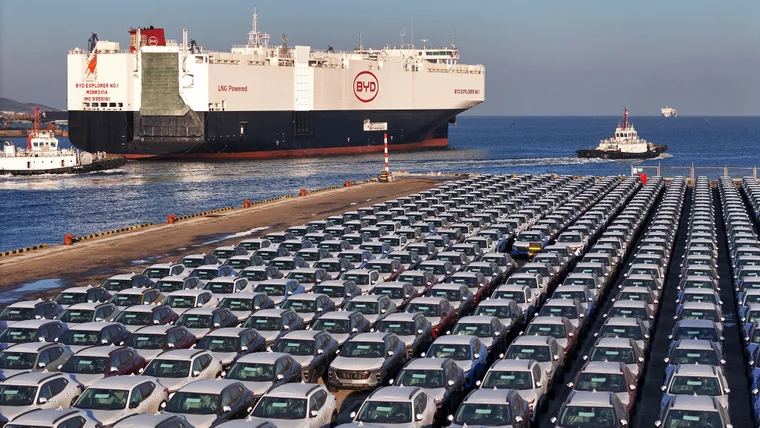
Look at what renting costs. A car carrier holding about 6,500 cars runs $95,000 a day, up from $50,000 in February, according to Clarksons Research. Most Asia–Europe carriers now crawl around the Cape of Good Hope — roughly a quarter more distance, up to fourteen more days per voyage. Moving a car from China to the Middle East went from $65 to $220 per cubic metre of cargo space. And underneath the price spike sits a quiet indignity: Chinese owners hold only about 10% of global car-carrier capacity, ships on order included. The world's biggest exporter rents its exit from somebody else's fleet.
So BYD is drilling a private tap. It announced $687 million for carrier construction back in 2022, after founder Wang Chuanfu complained of a shortage of export shipping capacity; eight ships entered service between January 2024 and September 2025; this year it told investors that shipping capacity had literally held back its exports. In September it sold 180,700 cars outside China — more than double a year earlier, and nearly 40% of total monthly sales — and it is aiming at more than 2.5 million overseas sales next year.
The number everyone quotes is the estimate that owning could cut BYD's cost to ship each car by up to 40% versus chartering. I read that number differently than most people do. Eighteen ships are spectacularly inflexible capital — steel that has to sail whether or not anyone needs it.
That 40% isn't an efficiency gain. It's the premium on an option: the option to keep shipping when the shared market breaks.
Here's the part I can't leave alone. The obvious story is war insurance, and the obvious story isn't wrong — it's just not the interesting one. Stephen Gordon of Clarksons Research puts it in order:
The very strong growth in Chinese exports, fueling strong Asia-Europe fronthaul demand growth, is the biggest single factor behind the increase in charter rates. Additionally, conflict in the Middle East has caused regional disruption and inefficiencies, which have helped to further tighten markets after a two-year period of gradual normalization.
Read that twice. The biggest single force squeezing shipping is the success of Chinese exports themselves.
Which cracks the story open. At home, Chinese sales of EVs and plug-in hybrids fell 12% over the first eight months of the year after buyer tax breaks were cut — and BYD's own domestic sales fell 33%. Meanwhile its exports keep outrunning overseas registrations, which, as Benchmark Mineral Intelligence's George Whitcombe points to, means a growing stock of unsold cars sitting abroad. The ships aren't only insurance against a closed strait. They're the exit valve for a home market that is shrinking under the company's feet. The fleet is how you keep a factory full when your own country stops buying.
It's a weapon against rivals, too. De Luca's point is blunt: carmakers that charter ride the charter market's swings, and owners don't. Whitcombe adds that Chinese automakers left without their own fleets face rising shipping costs in a weaker position to grow overseas. Geely runs one carrier on a long-term charter from Zodiac Maritime. Chery has a shipyard venture at Wuhu. Lei Xing, founder of AutoXing, is certain where this ends: "Geely... will be running its own ships eventually," he said. "You can bet on that."
There is a dissent worth taking seriously. Felipe Munoz of Car Industry Analysis calls the giant carriers "mainly a marketing exercise" — "a political statement against the established carmakers," a floating billboard for speed and resources. Sure, some of it is poster. But marketing doesn't explain Geely and Chery following, and it doesn't explain the configuration. BYD ships only EVs and plug-in hybrids, which need specially configured carriers, and most of the fleet burns liquefied natural gas because ports are tightening green-fuel rules. That is pre-complying with regulations that don't fully exist yet. Vanity doesn't order a fleet that fits the rulebook of 2030.
The ladder is the point. Tesla exports from Shanghai with no hulls of its own — other companies' carriers. Geely charters long-term. BYD owns. And one rung above all of them sits ASML, whose chief executive Christophe Fouquet said on Wednesday that the company cannot fully meet demand for its chip-making tools in 2027 or 2028 — despite planning 30% capacity increases in each of those years — and that customers now show "strong interest to already place orders for 2029 and sometimes even 2030." "A lot of our discussions with our customers now are shifting in fact beyond 2027," he said. When buyers start queuing years in advance for the right to buy something, they have stopped shopping and started securing.
| Company | Position on the ladder |
|---|---|
| Tesla | No hulls of its own — relies on other companies' carriers to export from China |
| Geely | Charters long-term — first car carrier runs on a charter from Zodiac Maritime |
| BYD | Owns — expanding from eight car carriers to eighteen by 2029 |
| ASML (one rung above) | Cannot fully meet demand in 2027 or 2028; customers showing strong interest in orders for 2029 and sometimes even 2030 |
Three industries, one week, one instinct: stop renting the critical layer.
Which brings me to the story that shows what renting looks like from the far end.
Overnight on October 13–14, Ukraine's drone units started losing their connection. The 7th Rapid Reaction Corps said it noticed "Starlink connectivity problems caused by data transfer speed limits" — "the drones kept flying, but the interruptions made them harder to control." A unit in the Zaporizhzhia region cancelled planned operations. According to President Zelenskyy's defense tech adviser, Serhii Beskrestnov, SpaceX had quietly imposed speed limits on terminals in motion, on the military-grade service, above roughly 100 mph.
Our defence forces received no warning of such a restriction, and this led to the failure of a number of missions.
That's Beskrestnov on Telegram. And then the detail that ought to make anyone who depends on rented infrastructure sit bolt upright: Ukraine's armed forces learned about the limitation from customer support, after filing a complaint. They found out what their own war runs on by opening a help ticket.
Trump insisted the U.S. was still sharing intel, but with relations spiraling Ukrainian officials and military units were on Wednesday accusing SpaceX of throttling a technology essential to their battlefield communications and drone operations. It was not immediately clear what might be behind the Starlink interruptions, though some Ukrainian officials said the timing could not be a coincidence given that Musk is a close Trump ally. The Ukrainian government has yet to receive a response from SpaceX, a Ukrainian official told NBC News, and Ukrainian units are already reporting issues with performance even at lower UAV speeds. Asked about the importance of the technology, Ukraine’s Charge d’Affaires to the U.S. Denys Sienik said Starshield is live saving. “The technology helps us save the lives of civilians and prevent more destructions in Ukraine caused by Russian side.” SpaceX had introduced speed limits on the operation of its Starlink satellite internet terminals overnight, according to Ukrainian President Volodymyr Zelenskyy’s defense tech adviser, Serhii Beskrestnov. “Our defence forces received no warning of such a restriction, and this led to the failure of a number of missions,” Beskrestnov said on Telegram. “It is obvious that this action cannot be a coincidence and is connected to the current political situation,” he added. An army unit fighting in the southeastern Zaporizhzhia region said Wednesday it had been forced to cancel some planned operations. The 7th Rapid Reaction Corps of the Ukrainian air assault forces said it began “noticing Starlink connectivity problems caused by data transfer speed limits” overnight, adding that the changes directly affected drones that use the service for in-flight control. “The drones kept flying, but the interruptions made them harder to control,” it said in a statement. Beskrestnov said that restrictions were specifically put on the operation of the military-grade version of Starlink at speeds above 100 mph. Starlink was also key for Ukraine’s aerial defenses as it was used to intercept the jet-powered drones that Moscow has unleashed on Ukrainian cities in recent months, he added. Asked about the importance of the technology, Ukraine’s Charge d’Affaires to the U.S. Denys Sienik said “the technology helps us save the lives of civilians and prevent more destruction in Ukraine caused by the Russian side.” Ukraine has reached out to the U.S. government and SpaceX for clarification on the rationale for the new restrictions but has yet to receive a response, according to a Ukrainian official. Ukraine’s armed forces learned about the limitations from customer support after filing a complaint regarding operational issues, the official said, adding that SpaceX had not warned of the move. Ukrainian military units were already reporting issues with drone performance at even lower speeds, the official added. The White House, SpaceX and Starlink did not immediately respond to requests for comment from NBC News. The disruption follows days of mounting tensions between Kyiv and Washington, as Trump pushes to lower gas prices ahead of the midterm elections. Trump’s latest reversal in his bid to settle the war saw him stun Kyiv by striking a diesel deal with Russia that upended years of U.S. sanctions. He then demanded that Ukraine stop attacking Russian oil refineries and called for Zelenskyy to be replaced. Trump also announced an “energy ceasefire” that neither warring side appears to have agreed to. Kyiv said it had refrained from striking Russian energy targets to respect Trump’s wishes, but the Kremlin has continued to hit Ukrainian energy infrastructure in its annual effort to leave its neighbor in the freezing dark sets in. https://t.co/DMPX9t2YcB
Read the original post on X
The motive is genuinely unknown, and I'm not going to pretend otherwise. Beskrestnov says the timing "cannot be a coincidence" and is "connected to the current political situation," and Ukrainian officials note that Elon Musk is a close Trump ally as relations spiral — but nobody has offered evidence, and SpaceX and the White House haven't commented. One roundup of Wednesday's reporting makes the precise point: SpaceX has restricted service in Ukraine before, with Kyiv's agreement. What's new is the tier it hit — the military one — and the silence.
🇺🇦🛰️🇺🇲 SpaceX caps Starlink speed for Ukraine's military terminals without warning; Kyiv calls the timing political, no evidence yet Ukrainian presidential adviser Serhii "Flash" Beskrestnov said SpaceX imposed a speed restriction overnight on Oct. 13 to 14 on Starlink terminals operating in motion, currently applied to the StarShield military service package and set at 100 mph (about 160 km/h), with no warning to Ukraine's forces. It disrupted "several" military missions; Ukraine's 7th Air Assault Corps said a drone unit in the Huliaipole sector canceled a number of missions because of "throttling." A Ukrainian Defense Ministry source confirmed speed limitations were discovered and the cause is under investigation. Reuters reports drones sometimes lose connectivity for up to 20 seconds even at 110 to 120 km/h, and some Ukrainian outlets say the cap was later tightened to 60 to 70 km/h, which is not confirmed. Reported by the Kyiv Independent, Ukrainska Pravda, CNBC and Forbes. NOT ESTABLISHED: Why SpaceX did it. Beskrestnov said the move "cannot be a coincidence" and is tied to the "political situation," and activist Serhii Sternenko said SpaceX likely acted at the Trump administration's request, but neither offered evidence. SpaceX, Elon Musk and the White House have not commented. SpaceX has used speed and geofencing limits in Ukraine before, with Kyiv's agreement; what is new is that this one targets the military tier and came without notice. The Kyiv Independent reported on Oct. 12, citing sources, that President Trump threatened to withhold intelligence sharing and weapons shipments to Ukraine to protect Russian oil refineries. Russia struck Kyiv with ballistic missiles two nights in a row; Zelensky said Kyiv "received no early warning from our partners" for the first strike, though the Air Force says warnings came for the next three waves. Ukrainian and US sources told the paper Washington has made no decision to stop intelligence sharing. At least three women were killed and 24 people injured in one Kyiv strike. Whatever the reason, a mid-war change to a satellite link that Ukraine's drone and mid-strike campaigns rely on shows the exposure of depending on a private provider. The immediate tests are whether the cap is lifted for registered military terminals, whether SpaceX explains it, and whether the US clarifies its position on intelligence and sanctions. Until then, the link to US pressure is an allegation. Sources: Kyiv Independent; Ukrainska Pravda; CNBC; Forbes; UNITED24 Media; Yahoo Finance.
Read the original post on X
Now put that next to the ships. This is BYD's eighteen hulls seen from the other end of the telescope: a country at war, running on a private company's satellites, discovering that the tap can be adjusted unilaterally, overnight, for reasons it is not entitled to know. BYD looked at that same world and decided the only acceptable answer to "who can change the terms?" is us.
The counterargument to all of this is the boring, correct-looking one: when the wars quieten, freight rates will fall, and eighteen hulls will look like a war premium paid at the top of the market. Maybe. Options get mistimed all the time; oversized bets are a real category of error. But notice that ASML's customers aren't scared of war — they're scared of shortage — and Ukraine's problem isn't pricing at all, it's sovereignty over a setting. Three different fears, one purchase.
So here's the habit I'm taking into the deal announcements of the next decade. Ask what each purchase insures. And ask who can change the terms without telling you. Private taps are expensive, inflexible, and faintly ridiculous right up until the shared world stumbles. A startling number of serious companies have decided that is a bet worth making anyway. That tells you something no earnings call will say out loud: this is what they expect the next decade to feel like.
Discussion
Join the conversation
Verify a private email address to comment. This does not subscribe you to Hajar Labs emails.
Comments